Here is a summary of a selection of projects that I have worked on throughout my career. For more details on my portfolio, feel free to reach out.
Technology development for automation of cardboard case opening
For more details, please contact me directly
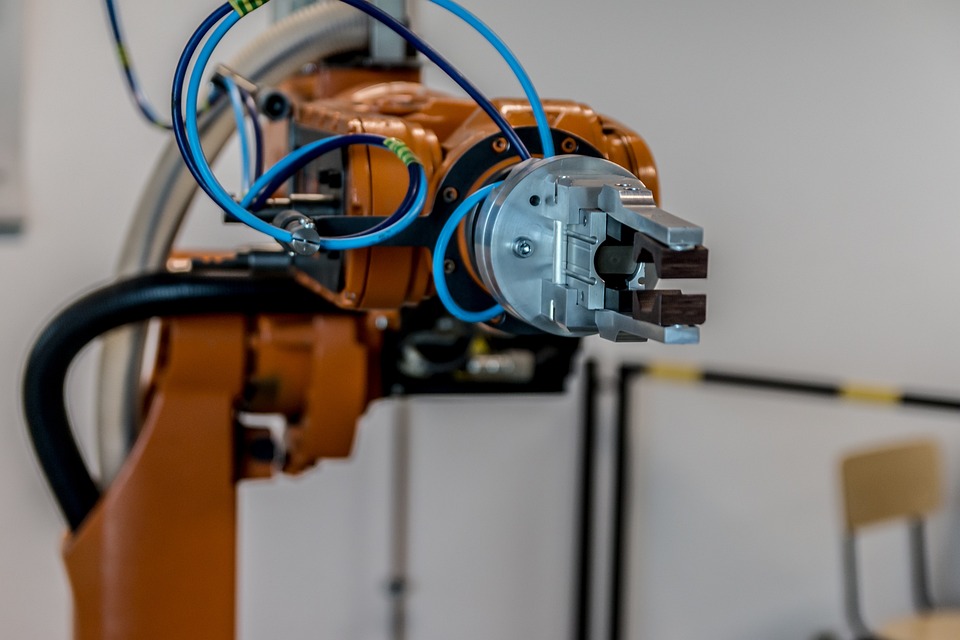
Design and testing of a soft robotic gripper
For more details, please contact me directly
Design and deployment of a dynamic gantry stage and custom robotic arm
For more details, please contact me directly
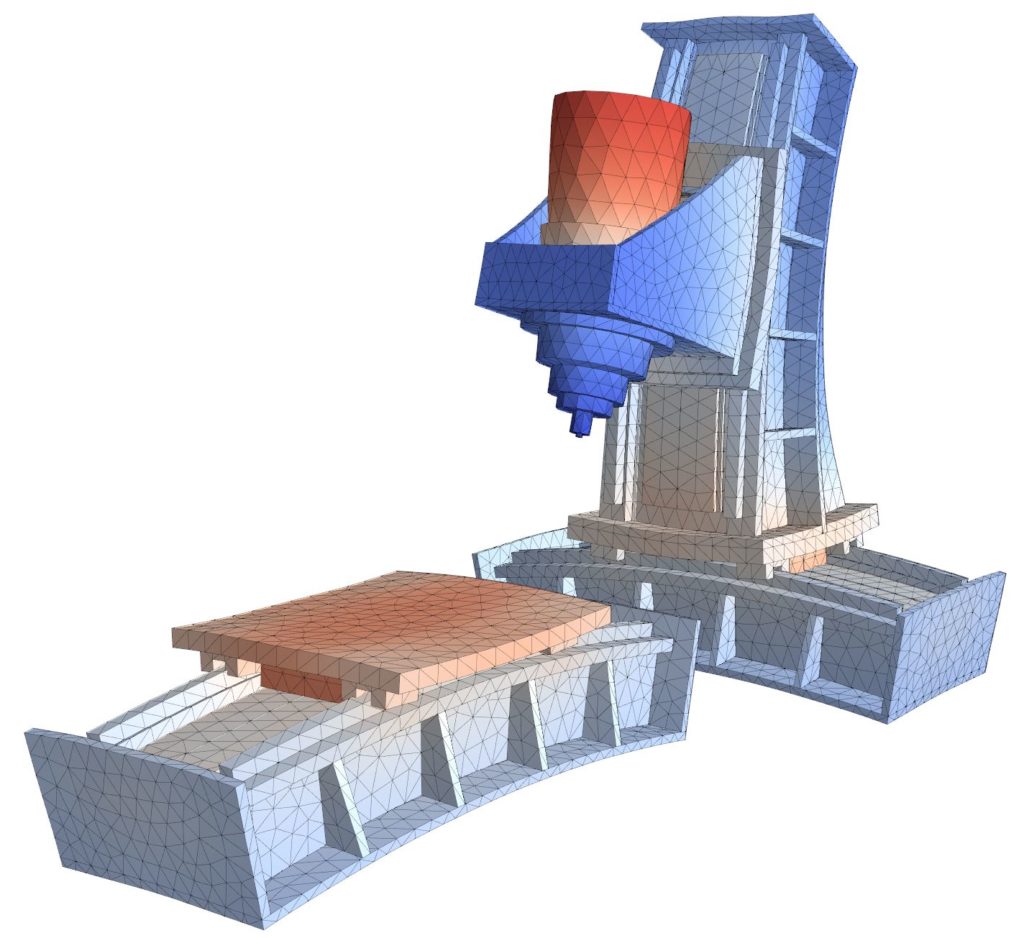
MORe is a simulation tool to analyze the geometric, static, thermal, and dynamic performance of machine tools. I joined this project in 2017 and became responsible to develop the thermo-mechanical module of MORe.
MORe offers the possibility to create efficiently a virtual prototype and test different design concepts. MORe has become a commercial tool to assist the development of new machine tool designs.
The MORe website provides detailed information about the features of the software.
This project focused on reducing the sensitivity of a 5-axis precision machine tool to changes of the air temperature.
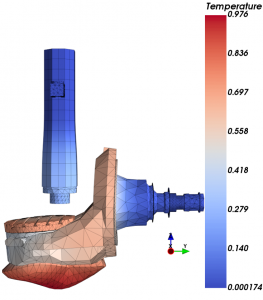
We designed a cooling system to homogenize the temperature distribution of the structure. A thermo-mechanical model assessed the performance of the new design with respect to sudden changes of the air temperature. We validated the thermo-mechanical model comparing the measured and simulated thermally induced displacements.
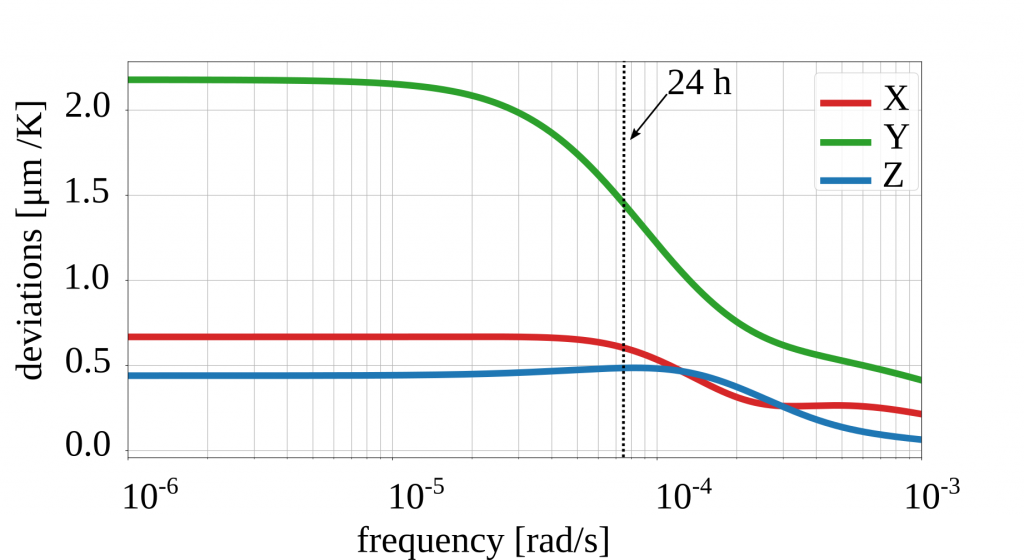
We evaluated the thermal response of the machine tool in frequency domain. This enabled the analysis of the thermal displacements at characteristic frequencies, such as the 24 h periodicity. Furthermore, we studied the effects of the errors at different axes positions.
In this project, we investigated how the heat dissipated during the operation of a rotary table affects the accuracy of the machine tool.
We developed a thermo-mechanical model to characterize the thermal response of the machine tool during the rotation of the table up to 1,200 rpm. We estimated the heat dissipated by the torque motor and bearings with a custom-made energetic measurement system.
We compared the thermo-mechanical response of the model with measurements of the displacements between tool center point (TCP) and a precision sphere. The validated thermo-mechanical model helped improving the online thermal error compensation strategies.
In order to enable many manufacturing processes, it is necessary to introduce cutting fluid in the machine tool. The supply of cutting fluid is particularly necessary when manufacturing parts with high material removal rate (MRR), such as cutting of lightweight aluminum alloys parts. In this project, we focus on how the introduction of cutting fluid affects the thermal errors on a large 5-axis machine tool.
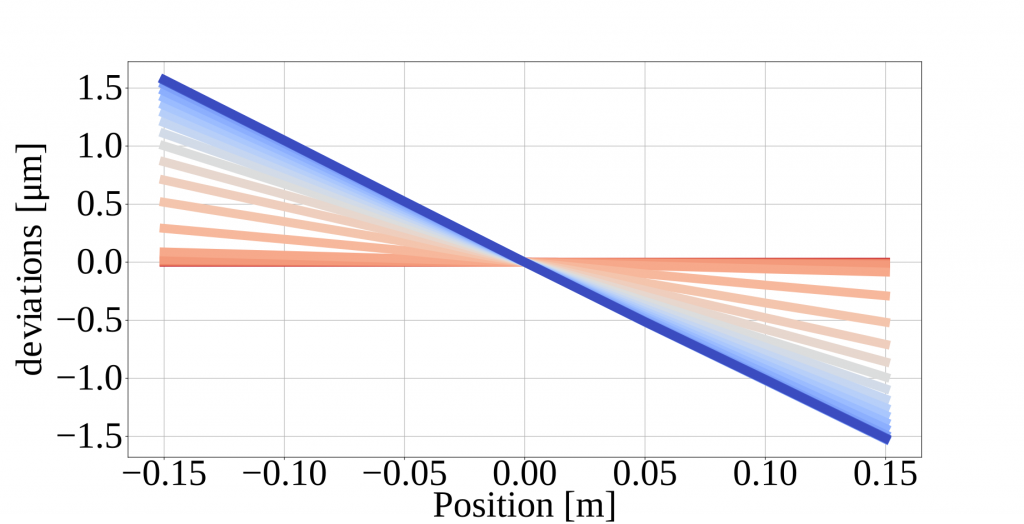
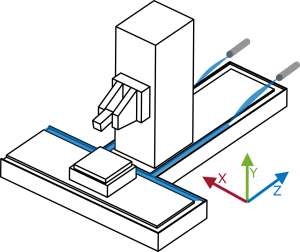
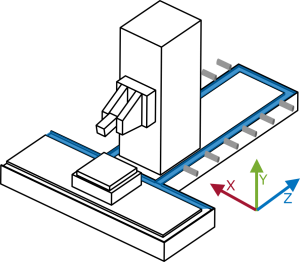
We investigated how the introduction of cutting fluid affects the tilt error motions of the Z-axis, We developed a custom measurement cycle with inclination levels to determine the position-dependent angular errors.
We proposed a re-design of the supply of the cutting fluid based on the results of the measurement and thermo-mechanical simulations. The homogenization of the cutting fluid supply succeeded in drastically reducing the tilt error motions of the Z-axis.